Stock turn is one of, if not the, most important metrics that you can use to measure the effectiveness of your spare parts inventory management.
However, like all metrics you do need to calculate it and use it in the right way.
One of the most common issues with stock turn measurement is that companies don’t calculate it in a standard way. This means that when they try to benchmark themselves against other organizations they get misleading results.
Sometimes they think that they are not doing vey well when they actually are.
However, the worst outcome is when they think they are doing well and they actually aren’t.
This article covers:
- Stock turn definition
- Stock turn for wholesale spare parts management
- Stock turn for in-house spare parts management
- Using stock turn as a benchmarking and continuous improvement metric
Definition
Turns is an inventory metric that measures the rate at which the inventory is used.
The most typical way to calculate turns is to divide the dollar value of stock issued in a year by the dollar value of stock held at the time of measurement.
For example, if you hold $500 of an item and issue $1,000 in a year, the turn is 1000/500 = 2. With turns, higher is better.
Stock Turn and Wholesale Spare Parts Management
Industries that sell their inventory typically measure turns at an SKU level. This helps identify if items are selling at a rate that is proportional to their holding levels. This is useful if you are holding stock with the aim of selling it. The turn measure tells you if the stock is moving and therefore popular with your customers and potentially profitable for you to stock.
Stock Turn and In-House Spare Parts Management
With MRO and spare parts used for maintenance and operations support measuring turns at an SKU level makes no sense.
This is not only because the items are not stocked for sale but also because, for this type of in-house inventory management, companies stock items that are not expected to turn or are not expected to have a high turn rate. Hence turns does not work as a decision indicator at an SKU level for this type of inventory.
However, turns does work with in-house spare parts inventory at an aggregate level, that is, by applying the measure holistically across all items held as inventory.
In this way turns is a measure of investment efficiency. A low turn indicates that there may be a mismatch between the total value held and the value used. Understanding the cause of this requires further investigation (assisted by having clearly defined stock categories). A high turn indicates that total investment level is more in line with the usage level.
Benchmarking and Continuous Improvement
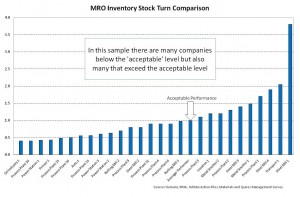 It is because turns measures the ratio between usage and holdings that different sized sites and warehouses can use it as a comparator, irrespective of their holding levels.
In addition, as an efficiency measure turns is independent of the issues surrounding the management of large or small inventories. This makes the turn ratio a good metric for benchmarking. Care must be taken, however to ensure that the sites in question measure their turns in the same way.
Finally, companies can use turns as a measure of their continuous improvement by comparing their stock turn today against their stock turn in the past. Again, this is independent of the actual holding level because good spare parts inventory management is about adjusting holding levels based on operational needs. This is exactly what the stock turn measures.
Click here for information on our Practitioner Playbook.
Posted by: Phillip Slater