Spare Parts Know How

Spare Parts Inventory Management Training

  • Log-In
  • Playbooks
    • Foundation Playbook
    • Operations Playbook
    • Practitioner Playbook
  • Teams + Companies
    • Foundations for Teams
    • Team & Enterprise Access
    • Inventory Optimization Software
    • Data Management Services
  • Expert Advisory Support
  • Resources
    • Open Access
    • Practitioner Access Digital Library
    • Books
    • Obsolescence Risk Calculator
    • Criticality Assessment Tool
    • ROP Calculator
    • Playbook Selection Tool
  • Contact
  • About
    • Past and Current Users
    • Testimonials
    • FAQs
    • Phillip Slater

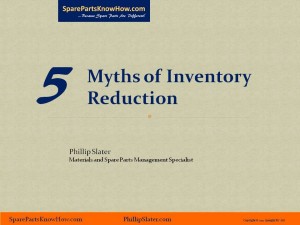
5 Myths of Inventory Reduction

April 30 spkhadmin

5 Myths of Inventory ReductionSpare parts inventory reduction has been a major focus of supply chain improvement initiatives for many years and success requires the application of both inventory fundamentals and good practice process.

However, it is the encouragement of appropriate spare parts management behaviors that delivers truly sustainable results. And it is in the area of appropriate behaviors, and the beliefs that drive them, in which there is usually the most hurdles to overcome.

These beliefs prevent companies from taking action to genuinely improve and so they limit their progress in the achievement of their spare parts inventory goals.

The beliefs are often based on ‘one-off’ experiences or implicit assumptions.

Sometimes they come from taking a limited perspective on business costs or not understanding the difference between cash and profit.

We have identified five common spare parts management beliefs that we call the Five Myths of Inventory Reduction.

To successfully effect an inventory reduction these myths need to be recognized and confronted. Only then can they be dealt with every time they are raised, in order to avoid them being the reason for inaction or lack of progress.

The Five Myths of Inventory Reduction are:

1. Economic quantities save money

2. Risk must be reevaluated to reduce inventory

3. Consignment stocks must cost more

4. Software will solve the problem

5. Putting items into inventory shares the cost

These myths are explained in the ebook 5 Myths of Inventory Reduction – available at the Pro Level home page.


For information on our Pro Level membership please visit our Pro Level page.


Posted by: Phillip Slater
 

Inventory Optimization

Join a Global Community

Trusted by:
+20,000 professionals in
+130 countries
See a sample of companies HERE

Open Access

Open Access to 20 Years of Spare Parts Management Know-How. No email required. No data collection. Just pure know-how.
Read more...

Foundations Playbook

Our Foundation Playbook is designed to answer question relating to the essential knowledge, tools, and techniques for effective spare parts inventory management.

Read more...

Operations Playbook

The Operations Playbook is the decision support resource for people who need to go beyond the basics and perhaps even revolutionize their company’s systems and approach.
Read more...

Practitioner Playbook

The Practitioner Playbook provides the most complete access to decision support resources, tools, and advanced content.
Read more...

Foundations for Teams

Foundatiosn for Teams is a live, online, interactive, team-based delivery of our Foundations Playbook content designed to provide your team with a common understanding of the basics of spare parts inventory management. Read more...

Need Team Access?

Our content can be used by individuals, teams, departments, or enterprise groups that need a shared approach to spare parts decision-making. Read more...

Latest Blog Posts

  • The Foundations Playbook is Now Live
  • A Shift in How Spare Parts Knowledge Is Delivered
  • Doing the Hard Things Makes Spare Parts Management Easier
  • Why Every Plant Thinks Its Spare Parts Challenges Are Unique (and Why They Aren’t)
  • Avoiding Survivorship Bias in Spare Part Procurement: From Efficiency to Resilience
  • Email
  • LinkedIn
  • YouTube

Copyright © 2026 IPIAIGHT PTY LTD.