For many years, SparePartsKnowHow.com has presented much of its expertise through training courses and supporting resources.
That structure made sense.
Training is important. Spare parts inventory management is often misunderstood, and many people who become responsible for spare parts have had little or no spare parts-specific education.
But over time, it has become clear that people do not always arrive with a simple training need.
Often, they arrive with a decision to make.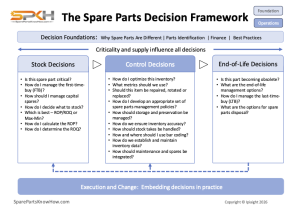
What should we stock?
How many should we hold?
Which parts are critical?
Why do we have so much obsolete inventory?
How should we set reorder points?
What should our policy say?
How do we improve operational control?
How do we stop making decisions based on pressure, habit, or guesswork?
These are practical questions.
They are also connected questions.
That is why SparePartsKnowHow.com is being redeveloped around a new structure: a spare parts decision support platform.
Stage 1 of that redevelopment is now live.
The Foundations Playbook is open and available to join.
Spare parts inventory management is a decision-heavy environment.
This is not an area where one policy, one report, one spreadsheet, or one training session solves the problem.
The number of items is usually large.
The demand profile is often uncertain.
The operational consequences of shortage can be severe.
And the people involved in the decisions often come from different functions with different priorities.
- A maintenance planner may see risk.
- A procurement person may see supplier constraints.
- A stores person may see transaction discipline.
- A finance person may see working capital.
- An engineer may see technical substitution or obsolescence.
- A manager may see performance, compliance, and accountability.
All of these perspectives can be valid.
The challenge is turning them into better decisions.
That requires more than access to information. It requires structure.
The previous structure of SparePartsKnowHow.com was built around courses and resources.
That was useful, but it did not always match the way people actually use the site.
Some users want a structured learning pathway.
Others want to solve a specific problem.
Some want a practical explanation they can use with colleagues.
Others want tools, calculators, templates, or frameworks.
Some need a foundation.
Others need operational improvement.
Others need deeper practitioner-level support.
Trying to force all of those needs into a course-based structure creates unnecessary friction.
The redevelopment is intended to reduce that friction.
The content is not being discarded.
It is being reorganized around the decisions and capability levels that users are trying to address.
The new structure is being developed in stages.
The first stage is now live:
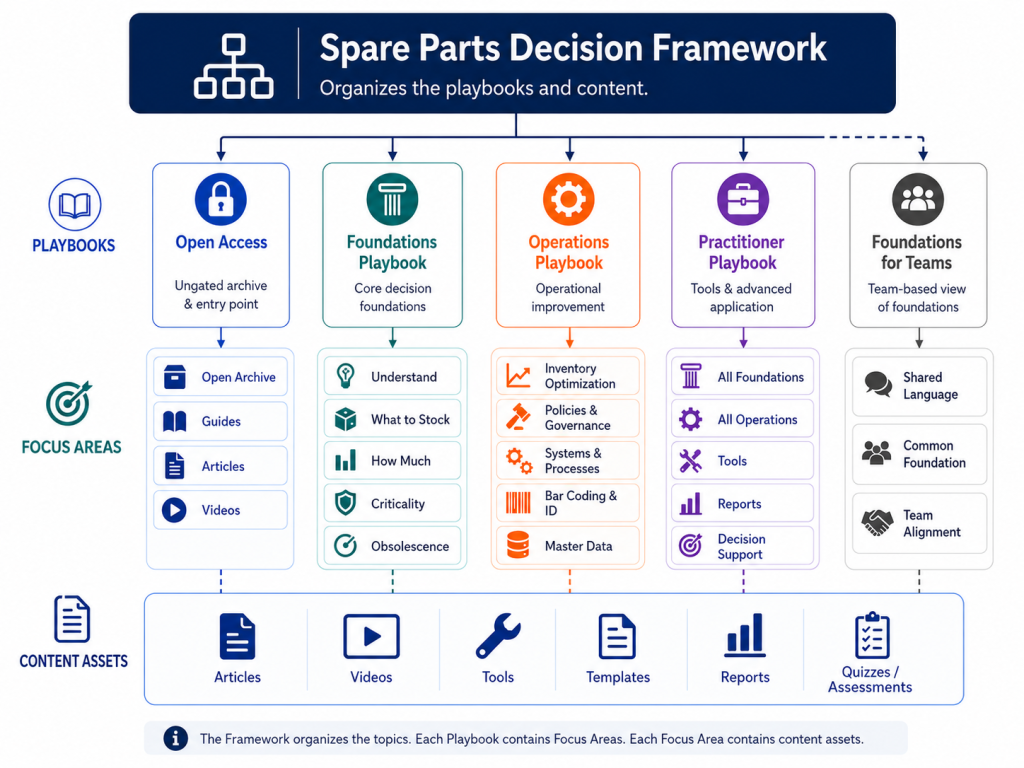
Foundations Playbook
The Foundations Playbook provides a practical spare parts-specific starting point.
It is designed for people who need to understand how spare parts inventory really works before trying to improve, optimize, or govern it.
It addresses the core ideas that underpin better decisions, including why spare parts are different from standard inventory and why generic inventory logic can produce poor outcomes when applied without adjustment.
The next stages are still in development.
Operations Playbook
The Operations Playbook will focus on practical operational improvement.
This is where topics such as optimization, policy, barcoding, process control, and implementation will sit.
The emphasis will be on improving how spare parts management is actually performed, not just understanding the concepts.
Practitioner Access
Practitioner Access will provide deeper decision support.
This will include tools, calculators, templates, frameworks, and advanced resources for people who need to work more deeply with spare parts inventory decisions.
Planned tools include reorder point, reorder quantity, last-time-buy, and operational capability assessment tools.
It may be tempting to jump straight to tools and advanced topics.
That is understandable.
People often want the answer quickly.
But in spare parts inventory management, the answer is only useful if the question has been framed correctly.
A reorder point is not just a calculation.
Criticality is not just a label.
Optimization is not just reducing inventory.
Obsolescence is not just old stock.
A policy is not just a document.
Each of these topics depends on underlying decision logic.
If that logic is weak, advanced tools can simply make poor decisions look more sophisticated.
That is why the redevelopment starts with the Foundations Playbook.
It provides the starting point for clearer thinking, better language, and more consistent decisions.
For users, the practical benefit should be a clearer pathway.
If you are new to spare parts management, you can start with Foundations.
If you are trying to improve operational performance, the Operations Playbook will provide the next level of practical guidance when released.
If you need deeper tools and practitioner resources, Practitioner Access will provide that support once Stage 3 is available.
This structure also makes it easier for teams.
Not everyone in a team needs to become a spare parts specialist.
But everyone involved in spare parts decisions benefits from a common understanding of the logic, language, and consequences of those decisions.
That is especially important in asset-intensive organizations where spare parts outcomes depend on cooperation across functions.
The redevelopment does not change the core focus of SparePartsKnowHow.com.
The focus remains MRO and asset-intensive industries.
The approach remains practical, grounded, and spare parts-specific.
The central message remains the same:
Spare parts are different.
And because spare parts are different, they require different thinking.
What is changing is how that thinking is organized and accessed.
Stage 1 is now live
The Foundations Playbook is now live and available to join.
This is Stage 1 of the redevelopment.
Stages 2 and 3 — Operations and Practitioner — will follow after further back-end development.
The aim is not simply to create a new set of product names.
The aim is to make SparePartsKnowHow.com more useful for the way people actually work.
Because in spare parts management, half the battle is knowing which question to ask.
The other half is knowing where to find the right answer.
The Foundations Playbook is live and available to join.
Posted by: Phillip Slater