 A multi-site organization does not need every location to hold the same inventory.
Different equipment, operating environments, supply arrangements and risk exposures will naturally produce different stocking requirements.
However, those differences should result from local circumstances—not from each location using a different decision process.
This distinction is critical.
Two sites may assess the same type of part and reach different stocking decisions.
That can be entirely appropriate.
One site may have access to a nearby supplier.
Another may be geographically isolated.
One may operate continuously.
Another may have regular shutdown opportunities.
The stocking outcome should reflect those differences.
The problem arises when the sites:
• use different definitions of criticality;
• apply different stocking rules;
• rely on different data;
• involve different functions;
• document decisions differently;
• interpret enterprise policies in conflicting ways.
In this situation, the organization does not have controlled local variation.
It has inconsistent decision-making.
The financial impact of inconsistency rarely appears in one place.
Instead, it appears through a range of operational and inventory outcomes:
• one site carries excess stock while another experiences shortages;
• similar items are catalogued differently and cannot be shared;
• local teams duplicate analysis already completed elsewhere;
• emergency purchases occur despite available stock at another location;
• policies are applied selectively;
• reports cannot be compared reliably;
• senior management lacks confidence in inventory data.
Each issue may appear small in isolation.
Collectively, they can represent a substantial cost.
Organizations sometimes resist enterprise standards because they fear the loss of local control.
That concern is understandable.
A central rule that ignores local operating conditions can create poor outcomes just as easily as uncontrolled local decision-making.
The answer is not to dictate every inventory setting centrally.
The answer is to standardize the decision process.
For example, every site might be expected to consider:
• the operational consequence of not having the part;
• the probability and pattern of demand;
• supplier lead time and uncertainty;
• available alternatives;
• repair or refurbishment options;
• the remaining life of the equipment;
• opportunities to share inventory;
• the total investment required.
The result may vary.
The logic should be recognizable and consistent.
Consistency also requires agreed terminology.
Words such as “critical,” “insurance spare,” “obsolete” and “slow-moving” may appear straightforward.
In practice, people often use them differently.
If “critical” means one thing to maintenance and another to procurement, the classification cannot reliably guide a decision.
If one site considers an item obsolete after a set period without demand while another requires an engineering review, enterprise reporting becomes difficult to interpret.
Definitions do not need to be complicated.
They need to be practical, understood and consistently applied.
This is where enterprise capability differs from simply providing training to individuals.
The organization needs people across sites and functions to work from:
• the same principles;
• the same core definitions;
• the same decision framework;
• the same policy intent;
• the same expectations for documentation and review.
That does not remove local professional judgment.
It gives that judgment a common structure.
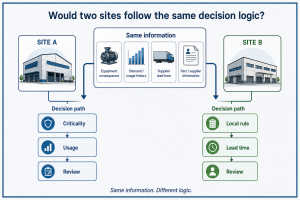
Consider giving two locations the same information about a spare part.
Would they:
• ask the same questions;
• involve the same functions;
• apply the same policy;
• document the reasoning in the same way?
They do not need to select the same quantity.
But if they do not follow the same decision logic, the organization has an enterprise capability gap.
The goal of enterprise spare parts management should not be complete uniformity.
It should be consistent, transparent and defensible decision-making across the organization.
That is what allows local knowledge and enterprise governance to work together.
If this resonates with you, it is time to take action. Start here >>> Enterprise Access.
Posted by Phillip Slater