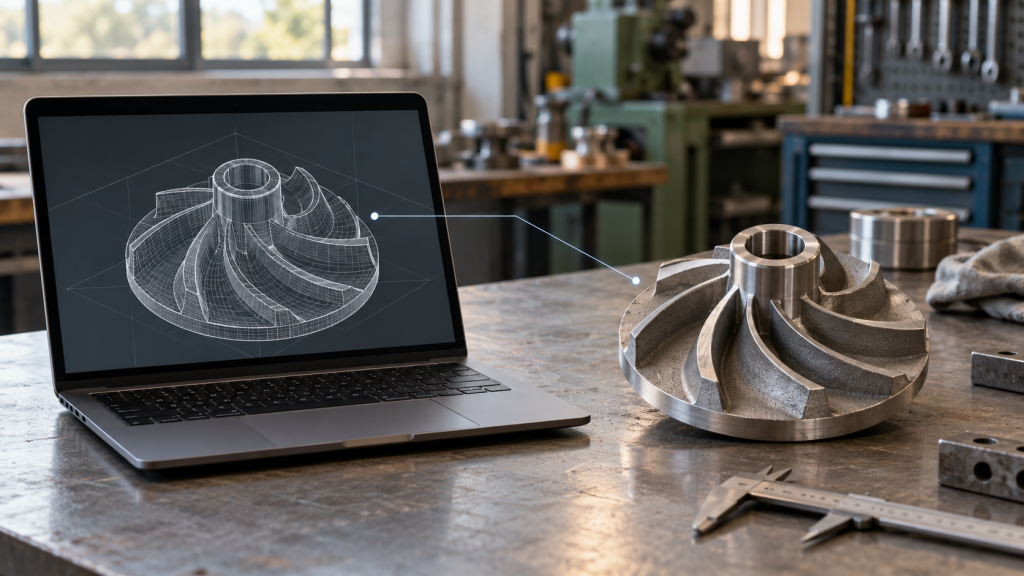
 A digital spare parts inventory file can preserve information about a spare part.
However, it does not, by itself, put a usable spare within reach of a maintenance team.
“Digital inventory” is being used to describe several ideas:
- a digital record of stock held in stores,
- a shared view of inventory across locations,
- a digital twin or model of a component,
- and a file that could be used to manufacture a part when needed.
These ideas are related, but they do not solve the same problem.
The most ambitious version is often described as replacing physical stock with a digital design that can be produced locally, perhaps through additive manufacturing.
That may be a useful supply option for selected components. It does not mean that the physical inventory problem has disappeared. It means the organization is considering a different way to make a part available.
A CAD file can be an important starting point.
Before it can support maintenance, someone has to establish that the design is current, complete, and authorized for use. The component must be manufacturable using available processes and materials. Its dimensions, tolerances, surface finish, and inspection requirements have to be understood. The finished item must meet the performance and safety requirements of the equipment in which it will be installed.
Those conditions can be demanding.
A visually similar part may not have the material properties or fatigue life required. A change to a drawing may affect fit, performance, or certification. A supplier may need to validate a production process. A site may need to demonstrate that quality records and revision controls are adequate.
The file therefore needs governance, ownership, and a controlled route from design to an approved item.
Digital production can shorten some supply routes, especially when conventional supply is slow, unreliable, or no longer available.
But the time to obtain a usable part includes more than the time spent printing or machining it. The organization may need to locate the correct file, confirm its revision, check permissions, book capacity, obtain material, manufacture the component, inspect it, and release it for use.
That total elapsed time should be compared with the lead time and reliability of the existing supply route.
If production capacity is shared, the part may wait in a queue. If specialist material is not on hand, procurement time remains. If testing or certification is required, manufacturing speed may have little effect on the time until the part is fit for service.
The practical question is not simply, “Can this part be made digitally?” It is, “Under what conditions is digital supply a better support strategy than holding the physical item?”
That decision still depends on the consequence of failure, demand pattern, equipment redundancy, time to manufacture and approve, supplier alternatives, and the availability of equivalent stock elsewhere.
It also depends on the economics. Digital production has setup, material, licensing, inspection, and storage costs of its own. A part that is expensive to hold may also be expensive to qualify for on-demand production.
For some items, the strongest strategy may combine a small physical quantity with an approved digital production route. The digital file may provide a contingency if the held item is used or the original source is lost.
For other items, conventional supply may remain more dependable or economical. The right answer can differ across components, even within the same equipment family.
Digital spare parts inventory supply may be especially relevant when an original manufacturer has stopped supporting equipment, a component has a long or uncertain lead time, or a small quantity is needed after a design has become obsolete. In those cases, a validated digital source could preserve access to a part that would otherwise be difficult to obtain.
Yet obsolescence also increases the need for care.
The original design may be incomplete, the material specification may be uncertain, and the equipment may have been modified over time. The organization needs to establish what is actually installed and what can safely replace it.
A digital reproduction of an old drawing does not resolve an unknown configuration or an unapproved design change.
Digital inventory should be assessed through the same disciplined questions used for any spare-parts support strategy.
- What failure or maintenance need does it address?
- What evidence shows that the part can be produced to the required standard?
- What is the end-to-end time to availability?
- Who controls the design and its revisions?
- How will quality be confirmed?
- What happens if the production route is unavailable?
These questions keep the discussion practical.
Digital production can add resilience and reduce dependence on a single supplier for selected parts.
It may also create new dependencies on design data, software, equipment, materials, and certification.
The balance needs to be understood before physical stock is removed or a new stocking rule is adopted.
Digital spare parts inventory is not a spare sitting on a shelf. It is one element in a supply arrangement. The decision is whether that arrangement can deliver an approved part, at the right time and cost, when the equipment needs it.
If this resonates with you, it is time to take action. Start here >>> Review Your Options.
Posted by Phillip Slater