Subject Area: Spare Parts Management Silos
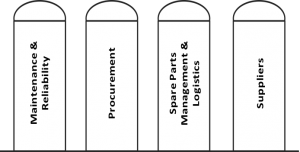 One feature of the modern corporation is the departmentalization of functions.
Companies do this to both create operational efficiencies and manage the span of management control.
Thus, most organizations will have, among others, an operations group, maintenance department, storeroom and logistics, purchasing and procurement, and finance.
But what happens when these functions overlap?
This is the reality of spare parts management silos.
Each of the different corporate functions mentioned has an influence on your materials and spare parts management outcomes.
Yet, typically, each operates independently, often with little incentive to coordinate activities to improve the overall business results.
This is classically called functional silos.
That is each group doing what it thinks is needed, based on its own specific function.
In effect, each functional group looks at the same activity and literally sees different things.
This ‘silo effect’ results in a lot of blame and even some anger when things don’t go right.
The storekeepers see a bunch of SKUs (stock keeping units) that they receive, store, issue, count, care for, and requisition.
They get yelled at by Maintenance and Operations for not having enough parts and by Finance for having too many.
The Maintenance department sees the inventory as one of the elements needed to efficiently repair the company’s machines and other assets.
They get yelled at by Operations if the part is not available when it is needed and downtime results.
In turn, the Maintenance people yell at Stores to speed up the issue process and to make sure that everything is stocked.
The people in Stores yell at Maintenance for not telling them how many of a part was really needed or that the part was needed at all.
The Purchasing team see all the hard work they do to source the parts, locate obsolete parts, and negotiate the best prices and terms.
They are yelled at by Maintenance for taking too long when buying parts for breakdowns.
They are yelled at by Finance to save more money.
Which then means that they get yelled at again by Maintenance for buying cheap parts that do not last.
They, in turn, yell at Maintenance to give them more time and not have so many emergencies.
The folks in Finance see money tied up that they believe could be used better elsewhere.
They yell at Stores, Maintenance, and Purchasing to cut costs, cut inventory levels, and stop spending so much money. They see fixing things as a pure expense.
They get yelled at by everyone else for asking for too much to be achieved from too little.
Without a team approach to spare parts inventory management, it seems that everyone is yelling at everyone else!
But what if they could implement a team-based approach, if each group could understand the perspective of the others?
What if they could understand what they were collectively trying to achieve and the constraints within which they were working?
Maybe then they could have a meaningful discussion about the management of materials and spare parts inventory.
And maybe then they could work out a way to collectively improve the overall business results.
With spare parts inventory management, being efficient and effective means minimizing your inventory investment while maximizing your spare parts availability.
This just cannot be achieved without the true collaboration of the entire team whose actions influence this result.
That, in turn, requires team training to make sure that everyone is ‘on the same page’.
It is precisely because the issues are many and the nuances subtle that here at SparePartsKnowHow.com we have developed as a platform to access a wide range of resources relating to spare parts inventory management and optimization.
Author: Phillip Slater