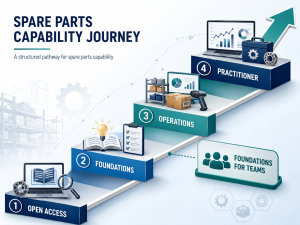
 Since opening the Operations and Practitioner Playbooks, one question has naturally come up: Which Playbook is right for me?
The answer does not depend only on your job title or how many years of experience you have.
It depends on the question you are trying to answer and the work you need to do.
The three Playbooks are not different quantities of the same information. Each supports a different stage of spare parts capability.
Start with the Foundations Playbook.
Many poor spare parts decisions begin with the assumption that all inventory can be managed using the same logic.
It cannot.
Spare parts are affected by equipment criticality, irregular demand, uncertain lead times, obsolescence, downtime consequences and the need to hold items that may rarely be used.
Foundations explains these differences and the decision principles that follow from them.
It is particularly useful when you want to:
• improve your own understanding;
• introduce someone to spare parts management;
• create a common language across different functions;
• make more consistent stocking and criticality decisions.
Foundations helps people understand the decisions.
The Operations Playbook is the next step.
Understanding individual decisions is important, but organizational outcomes are also shaped by policies, processes, data, metrics, responsibilities and operating discipline.
Operations addresses the management system around the inventory.
It is intended for people working to improve areas such as:
• inventory optimization;
• policy development and implementation;
• metrics and reporting;
• inventory accuracy;
• spare parts identification and cataloging;
• storeroom procedures;
• repairable spare parts;
• implementation and continuous improvement.
Operations helps organizations build capability.
The Practitioner Playbook is designed for active application.
It provides access to structured learning, but that is only part of its purpose.
Practitioner also provides a collection of practical resources that can be used when a particular issue arises, including calculators, assessments, templates, reports, specialist materials and an extensive digital library.
You do not need to work through every item before receiving value.
You may visit because you need to:
• check a reorder point;
• assess an obsolescence risk;
• evaluate an inventory reduction opportunity;
• develop or review a policy;
• prepare for a stocktake;
• investigate a data-quality issue;
• find guidance on a problem you have not encountered before.
Practitioner helps people apply the methods.
Foundations: Understand the decisions.
Operations: Build the capability.
Practitioner: Apply the methods.
Some people will need only one Playbook.
Others will begin with Foundations and progress as their responsibilities grow.
Practitioner brings the complete body of material together for those who want ongoing access rather than a single learning experience.
The important point is that you do not have to fit your needs into a conventional course structure.
Start with the problem you need to solve.