Spare parts inventory management is often treated as if it is just another form of inventory control. That is one of the reasons so many organizations struggle with excess stock, missing critical parts, poor data, inconsistent decisions, and recurring operational risk.
Spare parts are different.
They are not held for resale. They are not consumed in predictable production cycles. Many have irregular or intermittent demand. Some may sit on the shelf for years and still be essential. Others may appear important but no longer justify the space, capital, or management effort required to keep them. The consequence of getting a decision wrong can range from a minor inconvenience to extended equipment downtime, safety exposure, or major production loss.
The Spare Parts Decision Framework has been developed to help managers, engineers, storeroom teams, procurement specialists, maintenance personnel, and finance teams understand the decisions that sit behind effective spare parts management.
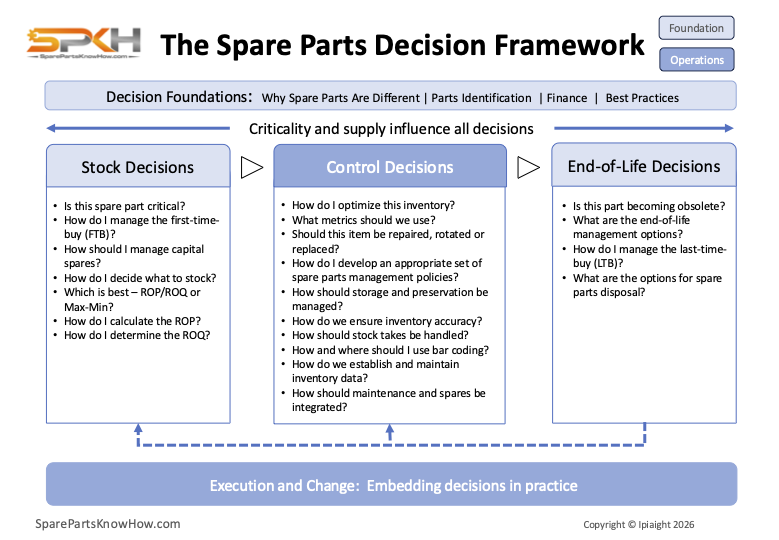
The framework organizes spare parts management around three major decision areas.
Stock Decisions address the first and most fundamental question: should this part be stocked at all? This includes decisions about standardization, criticality, first-time buys, replenishment triggers, and reorder quantities. These decisions determine what enters the inventory system and why.
Control Decisions focus on how parts are managed once they are in the system. This includes forecasting, inventory optimization, repairable spares, preservation, inventory accuracy, stocktaking, coding, bills of material, procurement, and the connection between maintenance and spare parts management. This is where policies, governance, systems, and processes become essential.
End-of-Life Decisions deal with obsolescence, last-time buys, disposal, and the point at which holding a spare part is no longer justified. These decisions are often delayed, but they are central to reducing waste and keeping the inventory relevant.
Across all three areas, criticality matters. A low-cost, easily available consumable should not be managed in the same way as a long-lead-time critical spare for a production bottleneck. The framework helps make those distinctions visible.
At SparePartsKnowHow.com, this framework also guides the structure of our content.
The Foundation Playbook explains the logic behind spare parts decisions.
The Operations Playbook helps teams apply Foundations logic to control decisions with more discipline, consistency, and confidence.
The Practitioner Playbook is the most complete content access level. It is for people and teams who need more than training. They need decision support.
The goal is simple: better spare parts decisions, made by better-informed people, using a shared structure and language.
What is Spare Parts Inventory Management?
A broader explanation of the discipline and the key decisions involved.
The Spare Parts Decision Framework
See how organizations can make more consistent stocking and inventory decisions.
Phillip Slater
Learn more about the creator of the Spare Parts Decision Framework and founder of SparePartsKnowHow.
Spare Parts Knowledge Hub
Access articles, tools, assessments, playbooks, and other learning resources.
Foundations Playbook
Build the knowledge required to understand spare parts decision-making and inventory performance.
Posted by Phillip Slater