Subject Area: Inventory Optimization Software
and High-risk Spare Parts
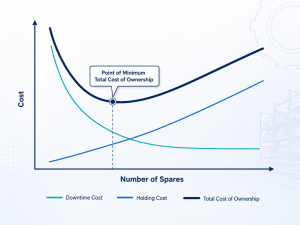 Most spare parts inventory problems come down to one difficult question:
How much inventory is enough?
Too much inventory ties up capital, creates excess and obsolete stock, and hides poor decision-making.
Too little inventory increases downtime risk, drives expediting, and leaves maintenance teams exposed when critical parts are not available.
The challenge is that spare parts inventory does not behave like retail, wholesale, or production inventory.
Demand is often intermittent. Lead times can be long or unreliable.
The true cost of not having a part available may be many times higher than the value of the part itself.
That is why inventory optimization for spare parts requires more than a standard inventory formula.
It requires decision support designed for the realities of maintenance, reliability, and operational risk.
The right software can help you move beyond guesswork, inherited settings, and spreadsheet-based reviews.
It can support decisions such as:
- calculating appropriate stocking levels
- reviewing reorder points and reorder quantities
- assessing service level trade-offs
- identifying excess and understocked items
- testing the impact of different stocking strategies
- quantifying inventory risk
- prioritizing high-value or high-criticality parts
- supporting better conversations between maintenance, procurement, finance, and stores
The goal is not to replace judgement.
The goal is to provide better evidence for judgement.
SparePartsKnowHow.com has a commercial relationship with a specialist software partner that provides inventory optimization and decision-support software for spare parts inventory.
The software is delivered and supported by that partner.
Our role is to help you understand whether this type of solution is likely to be a good fit for your needs and, where appropriate, introduce you to the partner for a more detailed discussion.
This matters because optimization software is not the right answer for every situation.
In some cases, the first priority may be training, policy development, data clean-up, or better governance.
In other cases, the organization may already have the foundations in place and needs a more structured way to review stocking decisions across a large number of items.
The first step is to clarify the problem you are trying to solve.
If you are interested in exploring inventory optimization software, the usual process is simple:
1. Initial discussion
We start with a confidential discussion about your current inventory issues, goals, and constraints.
2. Fit assessment
We consider whether optimization software is likely to be useful now, or whether another step should come first.
3. Partner introduction
Where there is a potential fit, we introduce you to the specialist software partner.
4. Software discussion and demonstration
The partner can then explain the software, demonstrate its capability, and discuss implementation, pricing, data requirements, and support.
5. Decision support
Where required, we can help you think through how this fits with your broader spare parts management strategy, training needs, and internal decision processes.
SparePartsKnowHow.com has a commercial relationship with the software provider.
This means we may receive a commercial benefit if you proceed with the partner solution following an introduction from us.
We only make introductions where we believe the solution is relevant to the spare parts inventory problems being discussed.
The starting point is not “Should we buy optimization software?”
The better starting point is:
What inventory decisions are we struggling to make, and what evidence do we need to make them better?
If your organization is trying to reduce excess inventory, improve parts availability, review stocking parameters, or bring more discipline to spare parts inventory decisions, inventory optimization software may be worth exploring.
Contact us for a confidential discussion about whether inventory optimization software is likely to be a good fit for your situation.