Spare parts improvement rarely fails because an organization lacks another formula, spreadsheet, or software setting.
It fails because decisions are made inconsistently, by different functions, using different assumptions about risk, criticality, demand, lead time, and cost.
The Roadmap for Spare Parts Decision Capability provides a practical pathway for changing that.
It shows how an organization can move from understanding its current position to creating a repeatable, governed approach to spare parts decision-making. Rather than treating training as a one-off event, the roadmap connects learning directly to implementation, ownership, and sustained business practice.
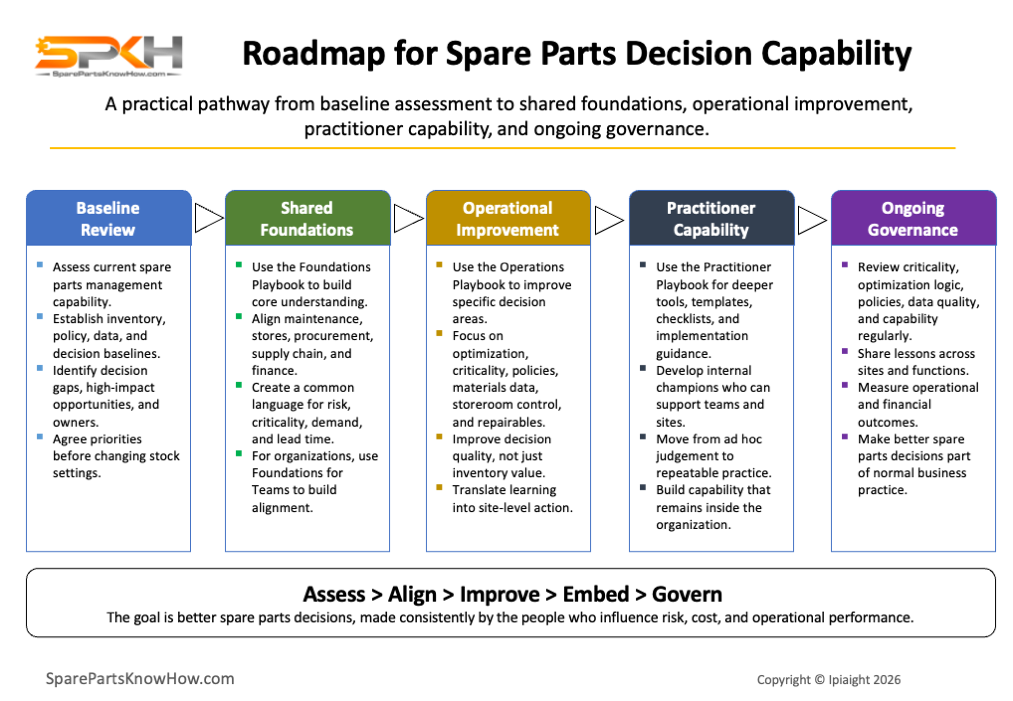
The journey begins with a Baseline Review. Before changing stock levels or introducing new rules, the organization assesses its current capability, policies, data, inventory, and decision practices. This identifies the most important gaps, opportunities, and priorities.
The next step is Shared Foundations. Maintenance, stores, procurement, supply chain, engineering, and finance need a common language and a shared understanding of how spare parts decisions affect operational risk and financial performance. Without this alignment, even technically sound initiatives can produce inconsistent results.
Operational Improvement then focuses attention on specific areas such as inventory optimization, criticality, policies, materials data, storeroom control, and repairables. The objective is not simply to reduce inventory. It is to improve the quality of the decisions that create inventory outcomes.
Practitioner Capability embeds the knowledge, tools, templates, and disciplined practices needed to turn learning into consistent action. Internal champions can then support teams, sites, and future improvement activity.
Finally, Ongoing Governance ensures that decision quality does not decline over time. Policies, criticality, data, optimization logic, and outcomes must be reviewed, measured, and improved as circumstances change.
The Roadmap for Spare Parts Decision Capability sequence is simple: Assess, Align, Improve, Embed, and Govern.
The result is stronger internal capability and better spare parts decisions, made consistently by the people who influence cost, risk, and operational performance.
What is Spare Parts Inventory Management?
A broader explanation of the discipline and the key decisions involved.
The Spare Parts Decision Framework
See how organizations can make more consistent stocking and inventory decisions.
Phillip Slater
Learn more about the creator of the Spare Parts Decision Framework and founder of SparePartsKnowHow.
Spare Parts Knowledge Hub
Access articles, tools, assessments, playbooks, and other learning resources.
Foundations Playbook
Build the knowledge required to understand spare parts decision-making and inventory performance.
Posted by Phillip Slater