
Reduce Spare Parts Inventory Investment Without Increasing Operational Risk
 Spare parts inventory has a habit of accumulating.
A part is stocked because it supports critical equipment. A reorder point is established. Additional stock is purchased because of a long lead time. Equipment changes but the inventory remains. Similar parts are held at different locations.
Individually, many of these decisions may have made sense at the time.
The problem is that they are rarely revisited.
Over time, the result can be millions of dollars tied up in inventory that may no longer be necessary.
Reducing Inventory Is Not the Same as Reducing Risk
Simply identifying slow-moving or non-moving inventory is not enough.
Some rarely used spare parts are held for very good reasons. Their value comes from protecting the organization against the operational consequences of not having them when required.
The objective is not simply to hold less inventory.
It is to identify where inventory investment can be reduced without exposing the operation to unacceptable risk.
That requires examining the decisions behind the inventory.
Where Do Spare Parts Inventory Reduction Opportunities Come From?
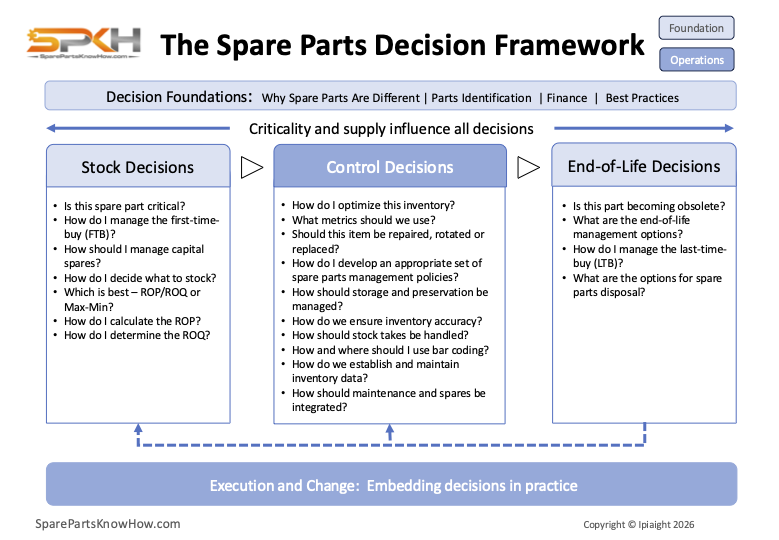 Meaningful inventory reduction can come from asking challenging questions such as:
- Do we still need to stock this part?
- Are we holding more than we need?
- Are reorder points and reorder quantities still appropriate?
- Is the equipment still operating?
- Are equivalent or interchangeable parts held elsewhere?
- Does the original reason for holding the inventory still apply?
- Are we continuing to replenish inventory that should simply be allowed to run down?
There is rarely one answer or one technique.
The opportunity comes from applying the right decision logic to different parts of the inventory.
Better Questions Can Change the Result
On an offshore drilling rig, removing existing spare parts inventory was difficult because of the location and logistics.
Instead, the Chief Engineer introduced a structured series of questions for every replenishment and new purchasing decision.
Within three months, the value of spare parts inventory had fallen by 10% — primarily because the team challenged what actually needed to be purchased and replenished.
Importantly, they did it themselves.
The spare parts inventory reduction result came from applying the decision process they had learned, not from having an external consultant review individual inventory items.
The objective wasn’t simply less inventory. It was less unnecessary inventory.
Take a Practical Approach
SparePartsKnowHow.com provides practical tools and guidance for people responsible for making and improving spare parts inventory decisions.
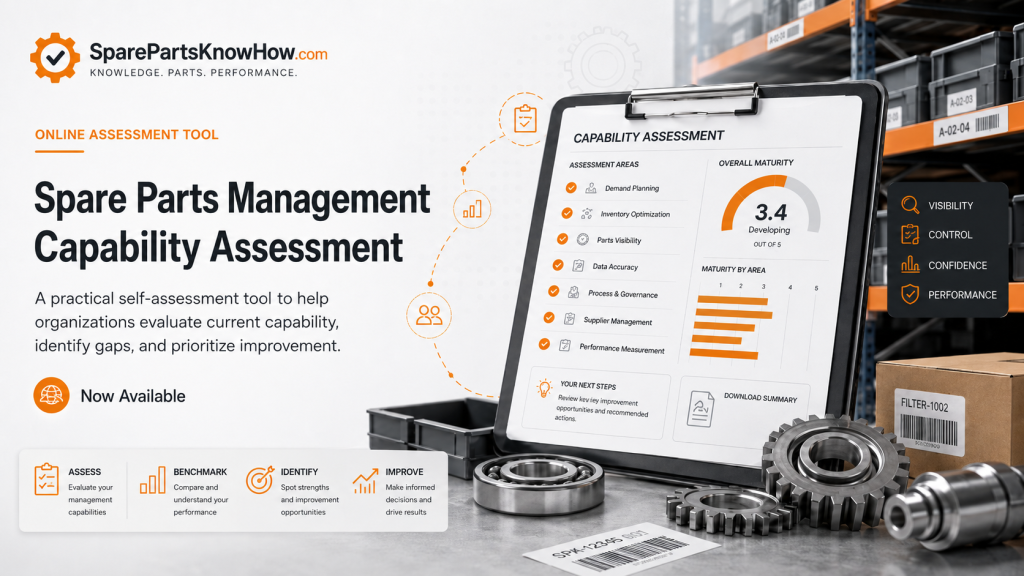 The Practitioner Toolkit includes resources for:
- Assessing current performance
Identify strengths, weaknesses and areas where improvement effort should be focused. - Reviewing stocking decisions
Apply structured thinking to whether an item should be stocked. - Reviewing inventory parameters
Calculate and challenge reorder points, reorder quantities and safety stock. - Identifying optimization opportunities
Use practical processes, checklists and guidance to systematically challenge existing inventory and identify inventory reduction opportunities. - Managing obsolete and surplus inventory
Understand where excess inventory comes from and how to prevent it simply accumulating again.
Want to see the tools available?
Explore the Practitioner Toolkit >>>
Improving Inventory Across a Team or Organization?
 Inventory optimization becomes more difficult when different sites, functions or individuals apply different decision logic.
SparePartsKnowHow.com also works with organizations to develop shared capability, consistent decision-making and targeted improvement programs.